
From overlooked to consistently cited in 90 days
When buyers ask AI engines for an outbound partner, Grow Big Ventures now shows up. In a single quarter it climbed from the floor of its category to overtake three established competitors, and it did it while posting the highest sentiment score among every brand tracked in its space.
Email growth engines for B2B
Grow Big Ventures designs and operates email outbound systems for B2B companies. Rather than running campaigns as a typical agency, they engineer the full stack, multi-domain sending infrastructure, verified and scored audience lists, hand-tuned personalization, and a campaign engine that's tuned every week, then hand it over for the client to own outright.
That model has built a real track record: a portfolio of 700+ B2B companies powered, reply rates well above industry benchmarks, and growth driven largely by referrals and documented client outcomes. Strong word of mouth, but a quiet footprint in the one place buyers had started to look first.
Invisible in the answers buyers now trust
Grow Big Ventures had grown the way strong outbound shops do: reputation, referrals, and results. But a widening slice of B2B buyers no longer starts with a referral. They open ChatGPT, Perplexity, or Gemini and ask which partner to use, and in those answers Grow Big Ventures was almost absent. At the start of the engagement its visibility across tracked buyer prompts sat at roughly 1%, near the bottom of its category, while other names owned the conversation.
The gap wasn't only being found. It was being understood as the right kind of partner, and being recommended when a buyer asked for options. If the engines can't do all three, a company is filtered out before the buyer ever knows it exists. Three distinct gates, each failing for a different reason.
Diagnose with the Three Gates, execute on the Citation Supply Chain
Most visibility tools tell you that you're missing. They don't tell you why, or what to do about it. Orbit Labs runs a diagnostic-to-execution system built on two frameworks: the Three Gates of AI Visibility to locate exactly where a brand loses the answer, and the Citation Supply Chain to win it back.
Grow Big Ventures' primary failure. The brand was rarely fetched into answers at all, so we baselined which prompts surfaced it, which competitors appeared instead, and which sources the engines pulled from, then made its key pages genuinely machine-readable.
We sharpened how engines classify the company, clarifying its category, its use cases, and where it fits in the buyer's decision, so it would be recognized as a relevant outbound partner rather than misread or skipped.
We built answer-first content engines could quote cleanly when a buyer asks for tools and partners to consider, so the brand moved from merely present to actively recommended.
Recognition and recommendation are earned through citations, and not all citations are equal. We worked three tiers of source, in order of how much an engine trusts them:
Owned
Answer-first pages and definitions on Grow Big Ventures' own domain, structured so engines can fetch and quote them directly.
Controlled External
Profiles and listings the brand controls but doesn't own, aligned and consistent so engines read one coherent entity.
Independent Third-Party
The hardest and most valuable: earned mentions in the sources engines lean on when a buyer asks for options.
AI visibility is the leading indicator. We're honest about the rest.
We treat AI visibility as the early signal and report it across three layers, from most controllable to most commercial:
Visibility signals
Mention rate, citation rate, share of voice, sentiment and average position on the topics the brand wants to own, tracked weekly against a locked baseline.
Traffic & clicks
AI-referred and organic traffic via GA4, split branded vs non-branded, to separate genuinely new demand from people who already knew the name.
Self-reported attribution
The most reliable read: when a prospect tells sales they found the brand through an AI assistant. That's the signal we trust most.
AI search makes attribution harder than classic SEO. A buyer often gets their answer inside ChatGPT or Claude without ever clicking, then arrives weeks later through a branded or direct search, so last-click reporting quietly credits “direct” for work AI did. We're upfront about that, which is why we lean on self-reported attribution and why every commitment we make is scoped to controllable output, never to a guaranteed outcome.
“What I trusted was that they never overpromised. No guaranteed rankings, just clear work and weekly numbers I could check myself. That's rare, and it's why I'd recommend them.”
Climbing while the category leaders slipped
Over the 90-day window, Grow Big Ventures' visibility rose from roughly 1% to 15%, climbing from the floor of the chart to overtake three established competitors. Its share of voice grew alongside it as the brand began appearing in more of the answers buyers actually see.
Grow Big Ventures also posted the highest sentiment score in its tracked set, a 70, along with the largest sentiment gain of any brand monitored. Its average position held roughly steady around #3.7, while several of the established leaders saw their visibility decline over the same period.
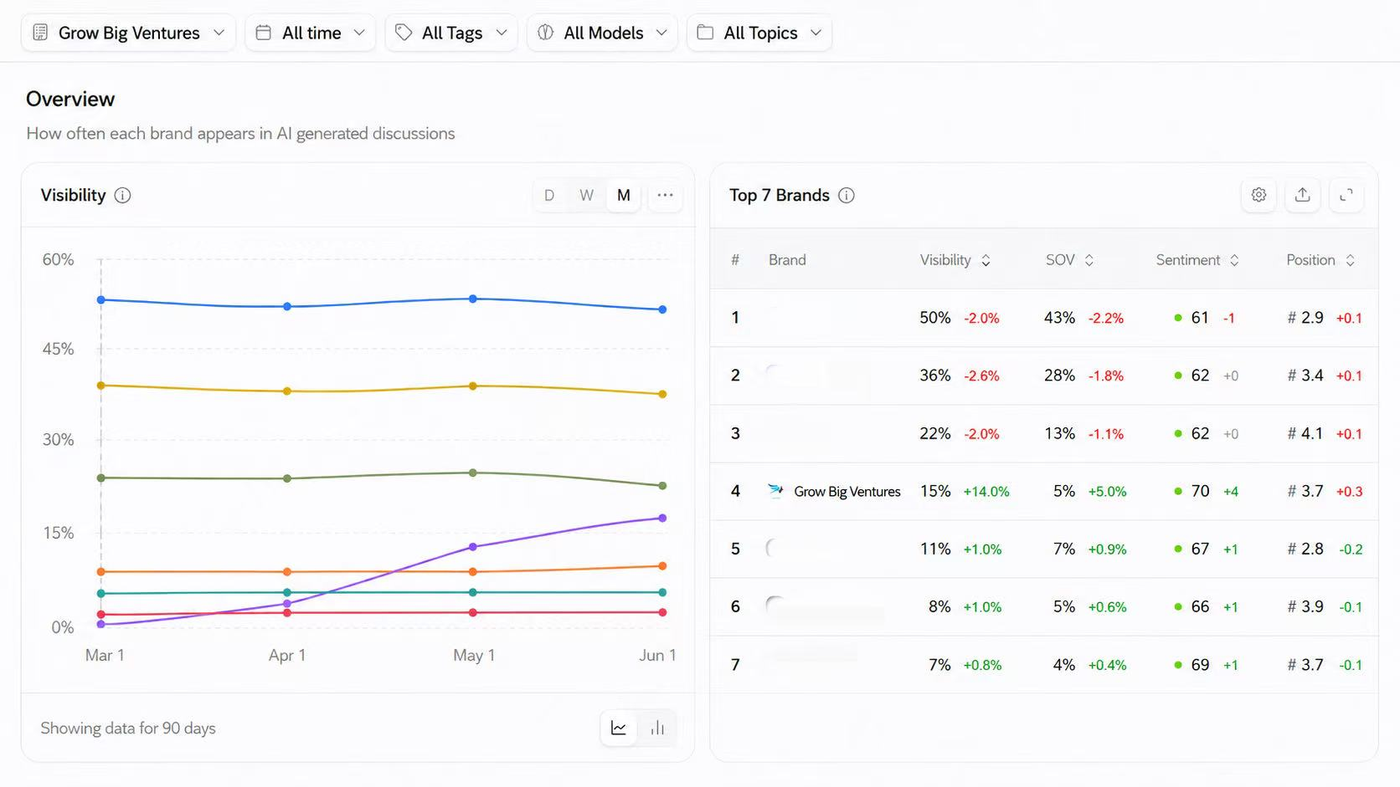
“We had the product. What we didn't have was a presence the moment a buyer asked an AI tool what to use, we just weren't in those answers. Inside a quarter, that changed. We started seeing more early conversations land with people who'd clearly already come across us, and Orbit Labs is the reason we're showing up where those conversations begin.”
Request your AI visibility baseline
The first step is a 20 to 30 minute scoping conversation. We'll review your category, your competitors, and the prompts your buyers are using, then recommend the right scope.
Book a 30-min call →